
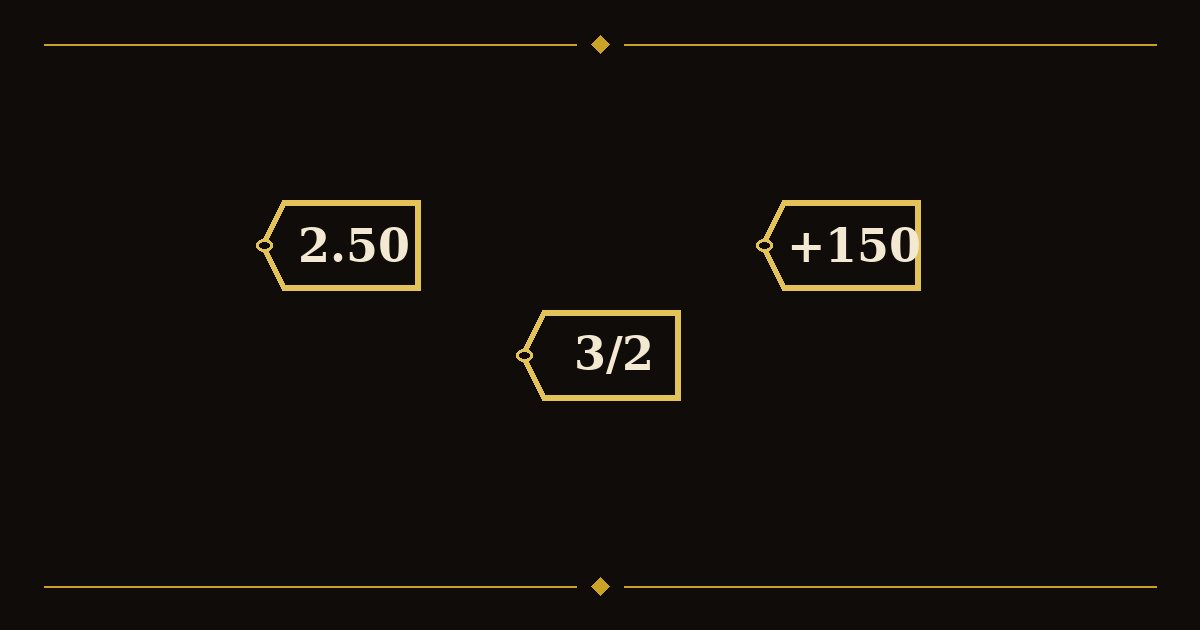
Open a sportsbook in Europe and you'll see odds like 2.50. Open one in the UK and it might show 3/2. Open one in the US and it's +150. All three can describe exactly the same bet — the notation just changes depending on where you are.
Decimal odds: the easiest to read Decimal odds show your total return per unit staked, including your original stake. Odds of 2.50 mean a 10€ bet returns 25€ if it wins — 15€ profit plus your original 10€ back. To find your profit only, subtract 1 from the decimal odds and multiply by your stake.
Fractional odds: the traditional UK format Fractional odds like 3/2 show profit relative to stake: bet 2 units to win 3. A 10€ bet at 3/2 returns 15€ profit plus your 10€ stake, for 25€ total — the same result as decimal 2.50, just written differently.
American odds: plus and minus American odds use a baseline of 100. A positive number like +150 shows how much profit a 100€ bet would win (150€ profit on 100€, so 250€ total). A negative number like -200 shows how much you'd need to stake to profit 100€ (200€ to win 100€ profit).
Converting between them The math connects all three: decimal = (fractional profit ÷ fractional stake) + 1. For positive American odds, decimal = (American ÷ 100) + 1. For negative American odds, decimal = (100 ÷ |American|) + 1. Most betting sites let you switch the display format in settings — useful for comparing odds across bookmakers without doing the math by hand every time.
Why this matters more than it seems None of these formats change the actual probability behind a bet. What changes is how easy it is to spot good value. Once you're comfortable converting between formats, you can compare odds from different sportsbooks side by side and see which one is actually offering you better value for the same outcome.
Whichever format you're reading, remember that odds reflect the bookmaker's implied probability, not a guarantee — betting should stay entertainment, with a budget set in advance and never money you need for something else.